My mother is 81 years old. She is sharp, funny, and independent. She manages her own household. She reads two newspapers every morning. She can argue politics with anyone and usually win.
She cannot use a smartphone.
This is not because she is stubborn or technophobic. She has tried. I have spent hours sitting with her, showing her how to open an app, how to scroll, how to tap the right button. She practices. She takes notes. Then she picks up the phone the next day and it has updated overnight, and everything looks different, and she is back to square one.
Last year, her doctor’s office switched to an online patient portal. To schedule an appointment, she now has to log in to a website, verify her identity with a code sent to her phone, and fill out a digital form. She called the office instead. They told her the phone line was “for emergencies only” and to please use the portal.
She did not see her doctor for four months.
This is not a technology problem. It is a justice problem.
The Numbers
Let me start with the facts, because they are alarming.
According to the Pew Research Center, about one in four Americans over 65 do not use the internet at all. Among those over 75, the number is closer to one in three.
Even among older adults who are online, many struggle with basic tasks. Nearly half of adults over 65 say they need help setting up a new device. About 40% say they are “not at all confident” using computers or smartphones to do things they need to do.
These are not small numbers. We are talking about tens of millions of Americans who are being quietly pushed out of modern life.
And the gap is getting wider, not narrower. As more services move online, the penalty for being offline grows steeper every year.
What They Are Losing
When we talk about the digital divide, it is easy to think of it as a convenience issue. Older people miss out on social media. They cannot stream movies. They do not shop online.
But the real losses are much more serious.
Healthcare. Telehealth exploded during the pandemic and never went back. Many doctors now prefer virtual visits for routine care. Patient portals have become the default way to view test results, request prescriptions, and communicate with providers. If you cannot get online, you are locked out of your own healthcare.
A study from the Journal of the American Geriatrics Society found that older adults with limited digital access were 40% less likely to use telehealth services. They had fewer follow-up appointments and worse management of chronic conditions.
Banking. Banks are closing physical branches at a rapid pace. Between 2017 and 2024, more than 5,000 bank branches closed across the United States. Many basic banking tasks have moved online: checking balances, transferring funds, depositing checks, paying bills.
For seniors who cannot bank online, the options are shrinking. Longer drives to the nearest branch. Phone menus that loop in circles. Fees for services that are free online.
Government services. Social Security, Medicare, the IRS, and most state agencies now push people toward online portals. Filing for benefits, checking claims, and resolving issues all happen online first. The phone alternatives involve long hold times and limited hours.
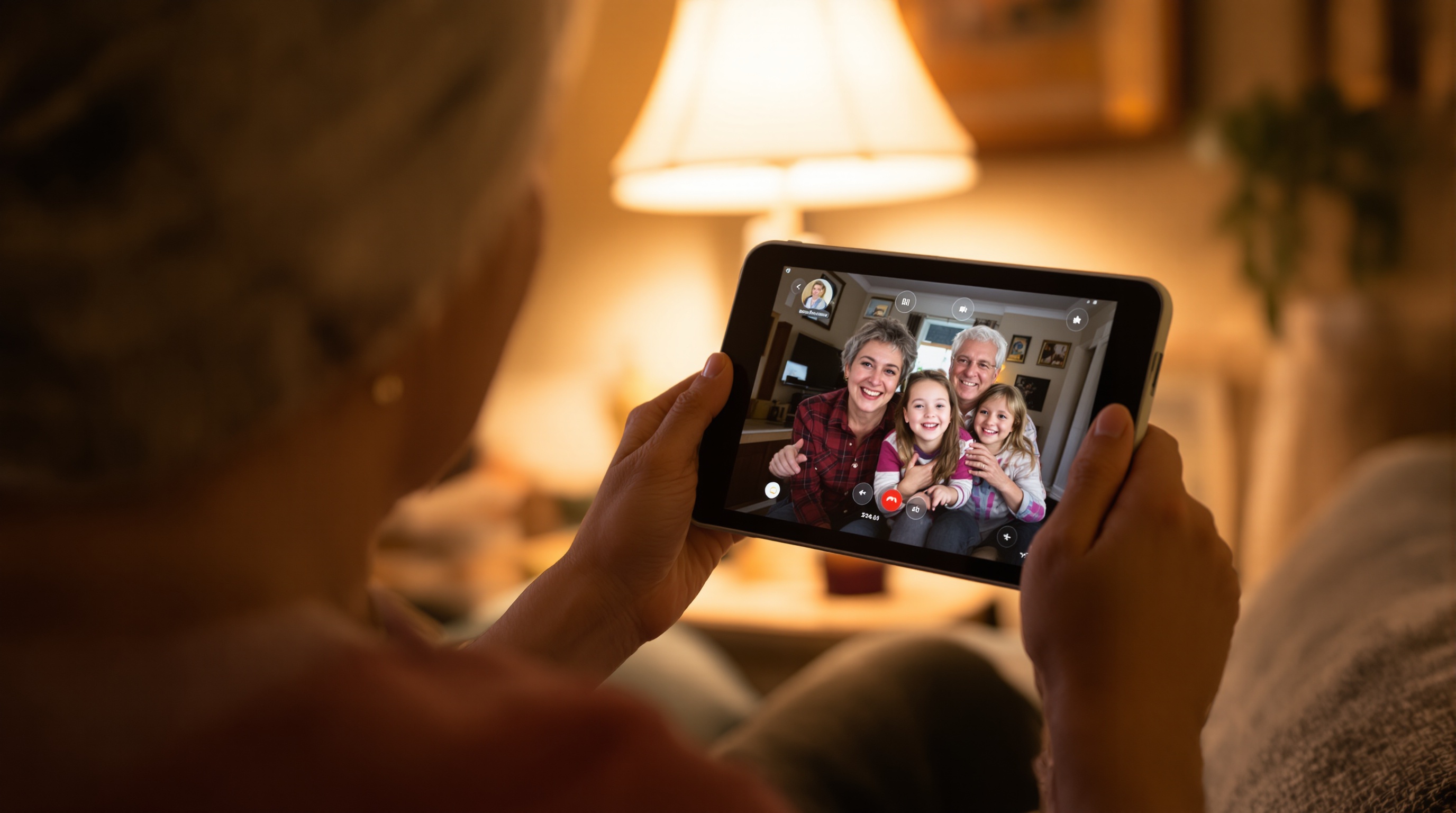
Social connection. This one hurts the most. During the pandemic, video calls became a lifeline for isolated older adults. But the seniors who needed that connection the most were often the ones least able to access it. Even now, group chats, photo sharing, and video calls keep families connected across distances. Seniors without digital skills are cut off from daily family life.
Safety. Emergency alerts, weather warnings, and community updates increasingly come through apps, texts, and social media. Older adults who are offline may not receive critical safety information.
Why “Just Teach Them” Is Not Enough
The most common response I hear is: “Well, someone should teach them.” As if the solution is a one-hour class at the library.
Teaching helps. I am not against it. But it is not enough, and here is why.
Technology changes constantly. My mother learns how to use her phone, and then an update changes the interface. A button moves. A menu disappears. A new verification step is added. For someone who learned the system through memorized steps rather than intuition, every change is a setback.
Cognitive and physical barriers are real. Arthritis makes small touchscreens painful to use. Declining vision makes tiny text impossible to read. Mild cognitive changes make multistep digital processes confusing. These are not failures of effort. They are realities of aging.
The pace of change is too fast. Tech companies release updates constantly. New apps replace old ones. Websites redesign without warning. Keeping up requires a level of continuous learning that is difficult for anyone, let alone someone who did not grow up with computers.
Class and access gaps compound the problem. Low-income seniors are less likely to have broadband internet, current devices, or access to tech support. Rural seniors face additional barriers. The digital divide is also an economic divide and a geographic divide.
The Design Failure
Here is what frustrates me the most: none of this is inevitable. The technology itself could be better.
Most digital products are designed by young people for young people. The buttons are small. The text is tiny. The processes assume you already know how things work. Error messages are written in jargon. Help pages are useless.
Where are the phones designed for people with arthritis? Where are the apps with large, clear buttons and simple workflows? Where are the patient portals that do not require a computer science degree to log in?
Some of these products exist, but they are rare and often treated as niche. They should be standard. When you design for the oldest and least tech-savvy users, you design something that works better for everyone.
Good design for seniors is just good design. Bigger text helps everyone. Clearer navigation helps everyone. Simpler processes help everyone. The fact that tech companies do not prioritize this is a choice, not a limitation.
What Should Change
I do not think the answer is to drag every 80-year-old onto the internet against their will. I think the answer is to stop punishing people who are not online.
Here is what that looks like:
Maintain non-digital options. Every essential service, including healthcare, banking, and government, must keep phone and in-person options available and fully functional. Not as an afterthought. Not with a 90-minute hold time. Real, accessible alternatives.
Require accessible design. Government-funded services should meet strict accessibility standards for older users. That means large text, simple navigation, clear instructions, and human help available at every step.
Fund digital literacy programs. Not one-time classes, but ongoing support. Drop-in tech help at libraries, senior centers, and community organizations. Patient, repeated, and available when people need it.
Design better technology. Tech companies need older adults on their design teams and in their user testing. If your product cannot be used by a 75-year-old with bifocals and mild arthritis, it is not done.
Recognize this as a civil rights issue. When essential services are only available online, people without digital access are being denied those services. That is discrimination, even if it is not intentional.
The Bigger Picture
The digital divide is not just a senior issue. It affects rural communities, low-income families, people with disabilities, and recent immigrants. But older adults are uniquely vulnerable because the divide hits at the same time as other losses: declining health, shrinking social networks, reduced mobility, fixed incomes.
A 30-year-old who cannot get online can probably learn. An 81-year-old who cannot get online may not be able to, no matter how hard she tries. And that is not her fault.
We built a society that runs on technology. We have a responsibility to make sure that society works for everyone, including the people who were already adults when the internet was invented.
What I Did for My Mother
I called her doctor’s office. I was polite but firm. I explained that my mother could not use the portal and that she needed to schedule appointments by phone. They pushed back. I pushed harder. They eventually assigned her a “patient navigator” who calls her to schedule visits.
It should not have taken that much effort. But it worked.
I also set up her phone with the simplest possible layout. One screen. Big icons. The five apps she actually uses. I taped a card to the back of her phone with step-by-step instructions for making a video call. I call her twice a week on video so she stays in practice.
Is this ideal? No. Is it sustainable for every family? No. It works for us because I have the time and the knowledge. Many families do not.
A Final Thought
My mother did not ask for the world to go digital. She was perfectly happy with phones that had buttons, banks that had tellers, and doctors who picked up when you called. She adapted to decades of change throughout her life. She learned to use ATMs, microwaves, and cable TV.
But the pace of digital change is different. It is faster, less forgiving, and more exclusionary than anything that came before. And the cost of falling behind is no longer just inconvenience. It is isolation, lost healthcare, financial vulnerability, and diminished independence.
We owe our oldest citizens better than that.
If your parents or grandparents are struggling with technology, help them. If your company designs products, include older users. If you make policy, protect non-digital access.
The digital divide is a problem we created. We can fix it. But only if we decide that leaving millions of people behind is not acceptable.
David Kim is a technology journalist and digital equity advocate. He covers the intersection of technology and aging. For corrections or updates, please contact us.
Topics in this story

It Is Time We Talk Honestly About Loneliness in Retirement
Retirement can bring freedom, but it can also bring deep loneliness. We need to stop pretending otherwise and start having real conversations.
The Best Free Apps for Staying Connected with Family Across the Country
Discover the best free apps for video calls, photo sharing, and group chats so you can stay close to family no matter the distance.

Smart Home Devices That Help Seniors Live Independently: A Beginner's Guide
Learn how smart home devices like voice assistants, smart lights, and video doorbells can help you live safely and independently at home.